
1. - What is SIP
SIP
- SIP - Session Initiation Protocol
- Signaling Protocol
- Controls Multi-media sessions
- Establish user presence
- Locate users - SIP Mobility
- Setup, Modify and tear down sessions
SIP RFC 3261
SIP is an application-layer control protocol that can establish,
   modify, and terminate multimedia sessions (conferences) such as
   Internet telephony calls.  SIP can also invite participants to
   already existing sessions, such as multicast conferences.  Media can
   be added to (and removed from) an existing session.  SIP
   transparently supports name mapping and redirection services, which
   supports personal mobility [27] - users can maintain a single
   externally visible identifier regardless of their network location.

   SIP supports five facets of establishing and terminating multimedia
   communications:

      User location: determination of the end system to be used for
           communication;

      User availability: determination of the willingness of the called
           party to engage in communications;

      User capabilities: determination of the media and media parameters
           to be used;

      Session setup: "ringing", establishment of session parameters at
           both called and calling party;

      Session management: including transfer and termination of
           sessions, modifying session parameters, and invoking
           services.

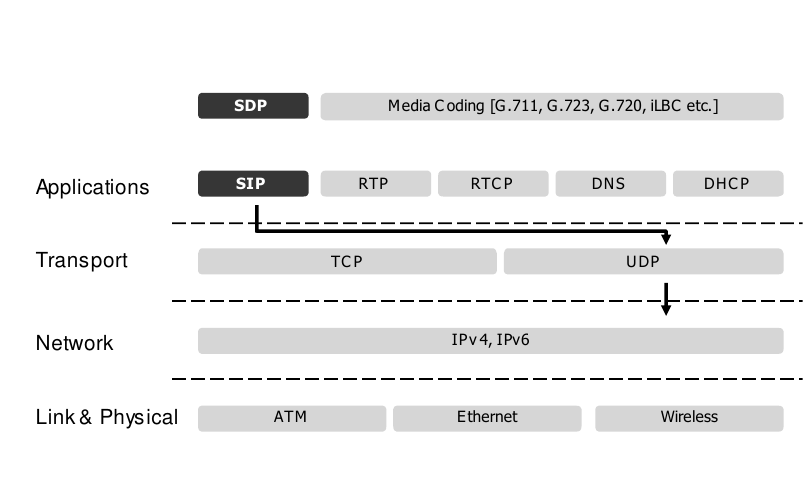
   SIP is not a vertically integrated communications system.  SIP is
   rather a component that can be used with other IETF protocols to
   build a complete multimedia architecture.  Typically, these
   architectures will include protocols such as the Real-time Transport
   Protocol (RTP) (RFC 1889 [28]) for transporting real-time data and
   providing QoS feedback, the Real-Time streaming protocol (RTSP) (RFC
   2326 [29]) for controlling delivery of streaming media, the Media
   Gateway Control Protocol (MEGACO) (RFC 3015 [30]) for controlling
   gateways to the Public Switched Telephone Network (PSTN), and the
   Session Description Protocol (SDP) (RFC 2327 [1]) for describing
   multimedia sessions.  Therefore, SIP should be used in conjunction
   with other protocols in order to provide complete services to the
   users.  However, the basic functionality and operation of SIP does
   not depend on any of these protocols.

   SIP does not provide services.  Rather, SIP provides primitives that
   can be used to implement different services.  For example, SIP can
   locate a user and deliver an opaque object to his current location.
   If this primitive is used to deliver a session description written in
   SDP, for instance, the endpoints can agree on the parameters of a
   session.  If the same primitive is used to deliver a photo of the
   caller as well as the session description, a "caller ID" service can
   be easily implemented.  As this example shows, a single primitive is
   typically used to provide several different services.

   SIP does not offer conference control services such as floor control
   or voting and does not prescribe how a conference is to be managed.
   SIP can be used to initiate a session that uses some other conference
   control protocol.  Since SIP messages and the sessions they establish
   can pass through entirely different networks, SIP cannot, and does
   not, provide any kind of network resource reservation capabilities.

   The nature of the services provided make security particularly
   important.  To that end, SIP provides a suite of security services,
   which include denial-of-service prevention, authentication (both user
   to user and proxy to user), integrity protection, and encryption and
   privacy services.

   SIP works with both IPv4 and IPv6.
More on RFC 3261 SIP
https://datatracker.ietf.org/doc/html/rfc3261
No Comments